She Despised Him in Her Heart

A portion of an earlier version of this story, named “Michal – A Cautionary Tale.” was read on the podcast Retelling the Bible.
By Matthew Mayer
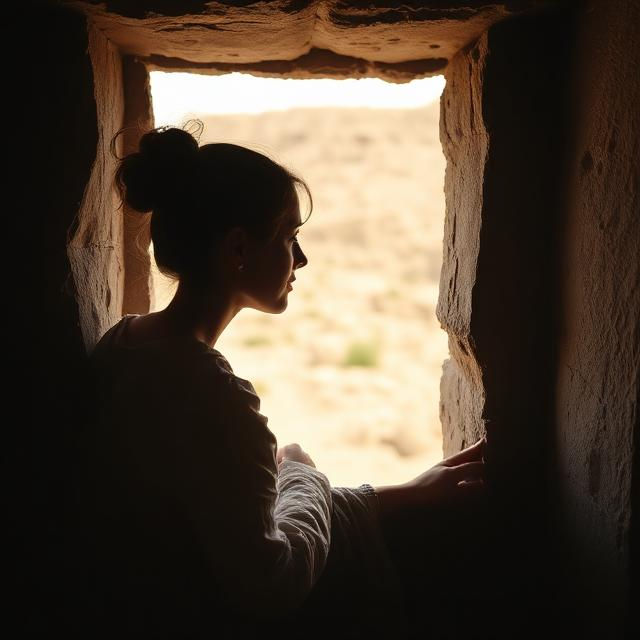
I.
Michal was just a little girl when the Philistines captured the ark of the God of Israel. It was a favorite story of hers to hear from her grandfather Kish. Michal loved stories. She had always been curious and inquisitive. As a girl, Michal would stand at the flaps of the tents, waiting for the men to return from the fields and begging them to tell her of any news or of any new stories they had heard. It was charming how Michal’s eyes would sparkle with excitement whenever she would ask for a story. And so, in the evenings, when everyone would gather to hear tales, Michal would always ask to hear the story of when the ark of the God of Israel went down to Philistia—her face beaming. Who could refuse?
The men who had been in battle told the tale one way. We brought the ark of God onto the battlefield to fight for us, and, boy, did God fight for us! You see, we let the Philistines “capture” the ark. We knew that God would wreak havoc in their temples and in their cities. It was an inside job!
That’s not how Kish told the tale.
Kish was a humble man. He had plenty enough wealth and had no need of more. He was satisfied with the portion that had been allotted to his family by Joshua. The boundary lines had indeed fallen for him in pleasant places. He had no military ambition to expand his territory like the other Benjaminites, who often went to war against the Philistines. These men believed that they could do no wrong because God was on their side. Literally. The Israelites had built their God a portable throne, and this throne was known as the ark of the God of Israel.
Kish knew better. He knew that the God of Israel could not be contained or coerced, could not be controlled. Kish knew that the God of Israel acted in ways incomprehensible to mere mortals. Thus, as Kish told the tale, he would describe how the Israelite army had suffered a humiliating defeat at the hands of the Philistines. The elders, believing they could wield God like one of their swords, sent soldiers to retrieve the ark of God from Shiloh. Eli, the priest, refused to give them his blessing, but neither could he deter them. His sons, Hophni and Phinehas, were all too happy to ingratiate themselves with the army. They were known to take extra portions for themselves from the sacrifices of the people; they were known to have raped the women who served at the tent of meeting. Hophni and Phinehas figured there would be plenty of both among the spoils of battle. The priest’s sons brought the ark of the God of Israel into the camp. Its arrival caused an uproar. The Philistines almost fled in terror at the surge in their enemy’s morale, but the Philistines held their ground. God, however, would not be contained. God would not stoop or bow to the army’s ambitions. God vacated the throne above the ark and abandoned Israel to fight for themselves. As the dust of the battle cleared, the Philistines had won again. The priest’s sons were slaughtered, and the ark of the God of Israel was captured.
The Philistines believed that because they had defeated Israel in battle, their god had defeated the God of Israel. They believed that they could contain the God of Israel and housed the ark within the temple of their god. But the God of Israel would not be contained. Morning after morning, the god of the Philistines was found bowing before the God of Israel! Morning by morning, until the idol began to crumble, and even its head and its hands fell off. Even the people were afflicted with cancerous tumors.
The Philistines moved the ark from city to city, hoping for relief, but affliction followed wherever the ark went. The Philistines could stand it no longer and returned the ark. The rulers of the Philistines set the ark upon a cart with gifts of gold and let the cattle find their own way to Israel.
Eventually, the ark was brought to Kiriath Jearim, to the house of Abinadab. There it remained all the days that Kish lived to tell this tale to his curious and inquisitive granddaughter.
II.
Michal stood at the mouth of her tent, as she had done so many times before, watching for news. Her father Saul had gone off to look for some wayward donkeys that belonged to his father, Kish. Saul had set off with one of the servants to look for the animal. Michal mapped out in her mind the route that they would take throughout the land of Benjamin and the hill country of Ephraim—Shalishah, Shaalim, Zuph. Michal, of course, had visited none of these places, but she heard tell of them in the tales that were brought home to her.
Her father had been gone for far too long. The donkeys had returned, but Saul had not returned with them. It seemed like the cattle that had returned the ark of the God of Israel, that the donkeys knew exactly where to go all along. Kish had begun to worry—he sent more servants to look for Saul to tell him that the donkeys had been found—and this caused Michal to worry also. Had her father fallen in with brigands? Was he struck down by the Philistines? Did he encounter a wild animal? Michal’s imagination ran wild.
Finally, one day, as Michal was watching from the mouth of the tents, her father appeared over the horizon, the servant with him. Michal rushed to Saul as he approached their dwelling place. She fell upon Saul’s neck and wept and kissed her father, her fright and anxiety giving way to relief.
“Abba! Father! You’ve been gone so long! Surely you have new stories to tell,” Michal said. She turned her charming smile toward her father, expecting him to smile in return, but Saul only looked troubled.
“In due time,” Saul said gravely.
Michal was crestfallen. She attended to her father’s needs in silence.
That evening Saul told them a tale beyond anything Michal could have imagined. He told his family how he had traveled with the servant throughout Benjamin and the hill country of Ephraim. They could not find the donkeys anywhere. Saul wanted to return home. He knew that Kish would worry, but the servant persuaded him to press on. They would go to visit the seer Samuel.
They arrived in Bethel. Samuel, it seems, had been watching at the door of the shrine for them. The man of God rushed out to meet them. He invited them to dine with him. Samuel had even set aside a portion of the sacrifice for them.
The next morning, Samuel pulled Saul aside and told him strange things. Samuel told Saul that he would be king over all Israel and anointed him with oil. Samuel told Saul of the strange meetings that would happen to him on the way home and that these events would be signs to him that what Samuel had told him would come true.
All happened as the seer had predicted. First, Saul met some of his father’s servants in Zelzah, near Rachel’s tomb. They told him that the donkeys had been found and that Kish was now looking for Saul. Next, he came across three men on their way to Bethel at the oak of Tabor. They gave Saul two loaves of bread to replenish his depleted provisions. Finally, Saul came to Gibeah and met a company of prophets. The spirit of God came upon him, and Saul joined them in their ecstatic’s.
“Is Saul also among the prophets?” Kish roared with laughter. “King of Israel? Israel needs no kings! I know Michal loves to hear new stories, but this is quite the fairytale you’ve made up. You need not be embarrassed about the donkeys, son. I am just glad you’ve made it home safely.”
Saul averted his eyes from his father, but Michal could see the pained expression on his face—as though he was being tormented by an evil spirit. She was not so sure that her father had made up this story.
“Why don’t you leave the storytelling to Kish?” Michal’s grandfather said. “I wouldn’t repeat that tale again. Not even to your uncle!”
III.
As Michal grew older, she continued to watch for new stories. But she no longer watched from the flaps of the tent. These days, Michal watched from the palace window. Her father had not been lying when he told his family about what the seer had told him. It was the last story that Saul had ever told her. Saul no longer had the time, but Jonathan always made time for his little sister.
Jonathan liked to tell Michal the tale of how their father was proclaimed king by the people of Israel.
“I went up with father to Mizpah,” Jonathan would tell her. “The seer Samuel had called the people together. He chastised them for asking for a king, and it almost seemed for a moment that he wouldn’t do it. ‘You have rejected God!’ Samuel told them. But eventually, he got down to business.
“Samuel held a lottery. It was a fix, though. We both know what father told us when he had gone looking for the donkeys. Samuel had already anointed father. Obviously, the lot fell to Benjamin, and then to the Matrites, and then to Kish, and finally to father. But do you know where father was?”
“Tell me!” Michal would cry. Of course, she knew. She had heard the tale many times before, but she had to play the role that was expected of her in Jonathan’s telling of the story.
“Father was hiding among the baggage!” Jonathan and Michal would always laugh at this part of the story.
It was the part, however, that Michal loved best. Jonathan had told her another story, the tale of when the people had first asked Samuel for a king. Samuel had given the people a grave warning that day. The king would take away their sons to serve in his army or to plow his fields. The king would take away their daughters to be his bakers. Their fields would be taken. Their wealth and the produce of their land would be taxed. Their own servants would become the king’s slaves. Even they themselves would become slaves to the king. Jonathan had only ever told Michal this story once. She never asked for it a second time. She did not want to hear it again.
And now Michal’s own father had been made king. These words could not be true. Michal needed them not be true. Yes, Saul had left behind their allotted portion. He had traded their tents for a palace. But he would never stoop so low as to do the things that Samuel had threatened. The man who hid among the baggage could not be the kind of tyrant king that Samuel described.
Could he?
IV.
In time, Michal grew tired of the war stories that Jonathan would bring home. Today we fought the Ammonites. Today we fought the Philistines. Today we fought the Amalekites. It certainly wasn’t good for their enemies to encroach on the land of Israel, but such violence, day after day, was a little desensitizing. Michal was getting bored of these sorts of tales.
But then one day, Jonathan brought home a story that was different than the other war stories. He and Saul had been gone for more than forty days. The armies of Israel had been encamped in the valley of Elah against the Philistines.
“There we were, camped out on one mountain with the Philistines across from us. We got ready to march down into the valley for battle, but the Philistines only sent one man. He was even taller than father. He must have been one of the Anakim! We could hear the Philistines chanting his name. ‘Goliath! Goliath! Goliath!’
“’ Silence!’ Goliath yelled at the Philistines. Then he yelled at us. ‘Why have you drawn up for battle? Am I not a Philistine, and are you not servants of Saul? Choose a man for yourselves, and let him come down to me. If he can fight with me and kill me, then we will be your servants, but if I prevail against him and kill him, then you shall be our servants.’
“We didn’t know what to do, so we didn’t do anything. We just held our position while the giant shouted. The next day, the same thing. Day after day, until David came. David’s brothers were in the camp, and he had come to visit them. Some of his brothers are nearly as big as father, but David is just a runt. He’s scrappy through.
“David heard Goliath shout at us and the Philistines chanting Goliath’s name. He started asking about it. You know how rash father is. He had promised that he would enrich whoever could defeat Goliath. No one would take him up on it except David.
“No one wanted to take David seriously. Goliath was so huge. David was so small. There was no way that David could win. But he puffed up his chest and said, ‘I may just be a humble shepherd, but whenever a lion or a bear would go after one of the lambs, I would rescue it. I have killed lions and bears. Surely the God of Israel will deliver this uncircumcised dog of a Philistine into my hand!’
“Everyone laughed except father. He looked grave, like he was wrestling with his spirit. ‘God be with you,’ he said. Father tried to give David his armor and his sword, but David refused them, saying that he could not get used to them. He only took his sling. Everyone laughed again, but we Benjaminites know how deadly a sling can be in the right hands.”
“Left hands, you mean,” Michal interjected.
Jonathan laughed. “You know what I mean. Anyhow, David went down the mountain and met Goliath in the valley. We could hear the whole Philistine army laughing.
“’ Silence!” Goliath yelled at the Philistines. He taunted David. David puffed up his chest again and said something to Goliath. Goliath lumbered toward him, and David slung a stone. It hit Goliath square in the forehead and took him down. David rushed forward and cut off that Philistine’s head with his own sword!”
Michal fell in love with David through Jonathan’s stories. The two had become fast friends, and so Jonathan was always coming home with stories of their exploits.
“Saul has killed his thousands,” Jonathan would say at the end of each story.
“And David his ten thousands,” Michal would answer.
V.
Michal looked out the window of David’s house, waiting for her husband to return. There was always a fresh war on with the Philistines. A battle here. A raid there. David would lead the armies of Israel. He was even more successful than Saul’s commander, Abner. And the stories he told Michal were like lyric poetry.
David’s success hadn’t escaped Saul’s notice. He heard the songs that people sang about him and David. He heard the stories that people told behind his back. All the power he held as king could not compete with David’s popularity. Saul longed to have David out of the way, but he feared how the people would respond.
So it came to be that Saul had given Michal in marriage to David. He had made the offer in an effort to control David.
“Only be valiant for me and fight battles for the God of Israel,” Saul told him. Perhaps, Saul thought, Michal can become a snare to David. The marriage would bind David to Saul. Michal could tell Saul of David’s comings and goings. If David spoke a cross word about the king, Saul would know. Saul would have the pretense that he needed strike David down.
Yet for all the stories Michal begged to hear, she told none. Saul had not expected that his daughter could actually be in love with David. For Michal, her marriage to David was her wildest dream come true. After all of Jonathan’s stories, it was like she had stepped into a fairytale.
And now, Michal stood at the window, watching. The hour had grown far too late.
David had been to the palace at her father’s request. It was a regular appointment. Lately, Saul had taken to falling into foul moods. He insisted that David play the harp for him whenever he felt tormented in his spirit. David could play beautifully, movingly even, but he told Michal that her father would simply glower at him while he played.
Suddenly, David came rushing into the house. He was breathless, his clothes disheveled.
“My husband,” Michal cried, rushing to him. “What has happened? What has kept you so late?”
“I was playing the harp for Saul,” David stammered. “He was grimacing at me like usual. He was holding his spear. Like usual. Just sort of casually spinning it in his hands.” David paused. “I could have sworn he meant to pin me to the wall with it. No. That can’t be true. The spear must have slipped. It was an accident, I’m sure.”
“My love,” Michal said. “That can’t have been an accident.” Michal went to draw the curtain. She thought she saw the outlines of her father’s men, watching the house. “If you do not save your life tonight, tomorrow you will be killed.”
“But Jonathan says that Saul has sworn not to put me to death.”
“What kind of oath is that to make? I love my father, but if he truly meant no harm, Jonathan would not have to make him swear such an oath.”
Eventually, Michal convinced her husband that he needed to flee. She knew exactly what she needed to do. Her grandfather Kish had many times told the tale of David’s ancestor Rahab, who had hidden the Israelite spies when they were scouting out Jericho, and later let them out through a window to escape. Rahab, Kish said, had seen the truth that this land had been given to the people of Israel by their God. She made the difficult decision to turn her back against her city to live according to that truth. Only her family was saved. Rahab stood, watching out the window for the siege of Jericho.
Michal, too, had seen the truth. The throne of Israel was being given to David by their God. Now, Michal told herself, she would have to be brave like Rahab and make the difficult decision to turn her back against her father’s house to live according to that truth.
Michal knew that David had been watched going into the house. There was no hiding him under stalks of flax. Saul’s spies must believe that David was still in the house if he was to have any chance of escaping. So Michal let David down out of the window she had been watching from earlier, and David fled. Then, Michal took an idol that her father Saul had once brought home from war with the Amalekites and laid it in David’s bed, covering its head with goat hair.
Michal did not sleep at all that night. She paced back and forth, watching for the morning and glancing occasionally out the window. She could still see Saul’s men watching the house. Eventually, the sun rose, and the men left their hiding places. They approached the house and pounded on the door.
“My husband is sick,” Michal told them, crossing her arms as she blocked the doorway to her home. The men scoffed and tried to peer around Michal to where the idol and goat hair lay in the bed. Michal stood firmly in their path. They dare not lay their hands on the king’s daughter.
“We’ll let the king know,” the men said and left.
Michal watched nervously out the window after Saul’s men had left. She knew that Saul could not be put off for long, and she feared what was coming next. Michal only hoped that she had bought her husband enough time to flee from her father’s murderous spirit.
It was not long before Saul’s men returned, and Saul with them. “The king has commanded us to enter the house,” they said, forcing their way into the house. “David is to be put to death, sick or well.” The men pushed past Michal to discover that an idol lay in the bed in David’s place.
Saul tore back the covers, tore his hair, and tore his clothes.
“I am undone!” Saul cried. “Why have you deceived me? Why have you let my enemy escape?”
Michal trembled in her soul, but she had resolved to tell a more convincing tale than her grandfather Kish had ever told. She had been rehearsing since last night. “Oh, father! How could you have given me away to such a brigand? David is no better than these uncircumcised Philistines!”
Saul was flustered. Michal’s own rebuke had caught him off guard. Emboldened by Saul’s hesitation, Michal continued.
“I tried to detain that son of Jesse, but he forced me to let him go. He said that he would kill me. He said, ‘If anyone catches David in the city, my men will fall upon the house of Michal.’”
VI.
After Michal had been abandoned by David, Saul refused to accept her back into his home. She was without child, so it was what the law prescribed, but Saul insisted that there had been no divorce. Even so, Saul had given Michal away to a man named Paltiel, who lived in the backwater town of Gallim. It may not have been the caves and mountains where Michal had heard that David was hiding, but it was practically an exile all the same.
So much for the man who hid among the baggage. Samuel had warned about what the king of Israel would do to the peoples’ daughters, but it seemed that even he could not imagine what the king would be willing to do to his own daughter.
Michal suspected that Saul did not really believe the tale she told the night that David escaped. She suspected that she had been given to Paltiel as a punishment. Paltiel was laughed at by other men, not only behind his back but openly, to his face, as well. Paltiel was different from other men. Her grandfather Kish had been gentle with Michal, but he was hard with everyone else. Paltiel was gentle with everybody. Nothing like the other men she had known.
Yes, Michal was certain that her father meant to humiliate her by giving her away to Paltiel, but Michal respected her new husband. She admired him even. But Michal just could not bring herself to love Paltiel. She knew, however, that Paltiel loved her deeply.
It was not without feelings of guilt that Michal pressed Paltiel for stories of her father’s and of David’s exploits. She knew that her questions pained him, but Michal could not help her curiosity. Though flushed somewhat with guilt, Michal still had that charming smile. Paltiel simply could not refuse her.
So it was that Michal learned that David had fled to Nob, from Nob to Gath, from Gath to Adullam, and from Adullam to Hereth. So it was that Michal learned that her father slaughtered the priests at Nob after he learned that David had been hiding there.
David was constantly on the move, Saul hot on his heels. Between the two of them, they left behind a trail of death.
Over time, as she heard these tales, Michal convinced herself that she no longer loved David. Still, her curiosity got the better of her. She couldn’t help but keep asking about what David and Saul were up to.
Once, when Paltiel had returned from the field, he brought Michal a new tale. David, it seemed, had set up camp around the wilderness on Carmel. He had assembled his own military band, and they were running a protection racket. When it came time to collect, one of the wealthy landowners refused to pay up. His name was Nabal. David sharpened his sword and called his men to arms. They marched on Nabal’s home. David never swung his sword, but Nabal still ended up dying under suspicious circumstances, and David still ended up with Nabal’s property and Nabal’s wife.
“Saul has killed his thousands,” Michal said quietly to herself, “and David his ten thousands.”
VII.
Michal stood grimly at the mouth of her tent, though she no longer watched for stories. Not long ago, Paltiel had brought home news of the death of her father, Saul, and her brother, Jonathan. The sparkle left Michal’s eyes that day. She wasn’t sure what she was watching for these days, but she expected something bad.
Messengers had come from Michal’s brother Ishbaal to speak with Paltiel. He had been downcast ever since. Usually, Michal could pry any secret from Paltiel’s lips, but this time, her husband would not share what the messengers had said to him. Paltiel had not spoken a single word since Ishbaal’s messengers departed.
Ishbaal was Michal’s kid brother. She had never liked him. None of Saul’s other sons ever had time for Michal except to tease her for her love of stories. “Always listening to stories. Never living them,” Ishbaal would jeer. Now, with Saul and Jonathan dead, the little shit was making his own bid for the throne.
What could he have wanted with Paltiel? Michal wondered to herself. For days, she watched from the mouth of her tent, knowing that nothing good would be arriving at her door.
On the sixth day after the messengers had come and gone, another company of men came traveling down the road toward Paltiel’s encampment. By the look of them, these men were warriors, but they were still too far off for Michal to tell who they were. For a brief moment, Michal hoped that it might be David.
Though Michal had told herself she no longer loved that ruddy boy, her heart jumped within her at the thought that David might finally be coming for her. But the thought soon turned to disgust. As the men drew nearer, Michal breathed a sigh of relief. It was only Abner. Abner, who was her father’s uncle and who had been the commander of his armies. Now he was propping up Ishbaal’s claim to the throne.
Michal watched with surprise as her husband, Paltiel, ran out to meet Abner. Surprise gave way to shock as Paltiel stretched out his arms to block Abner’s path. Shock gave way to horror as she watched Abner strike Paltiel across the face with the back of his hand, as though Paltiel weren’t even a man.
The exchange took seconds and did nothing to slow Abner down. It was clear as he drew closer that he was heading straight for Michal’s tent. Now Michal could see that the men in Abner’s company were the very same men who had come looking for David the morning after Saul had first tried to kill David. They sneered at Michal, seemingly taking pleasure in whatever cruel story was about to be played out.
“Don’t look so grim, my niece,” Abner said. “Today is the day you get to leave this backwater town.”
“I don’t understand,” Michal answered.
“Your husband, David, has sent for you. Pack your bags.”
Michal looked toward where Paltiel stood, cowering behind the men. His face was red from Abner’s blow. Or was it red from crying? Michal smiled at him.
“Paltiel is my husband,” Michal said, crossing her arms as she blocked the doorway to her tent.
“My niece, you really do not understand. This is not a request. This is a commandment from the king,” Abner said.
“My brother would not give me away to that brigand.”
“Your brother is not king.”
Michal was stunned. What could Abner have done? She shrank with fear. “How could you, uncle?”
“How could I what, dear niece? You and I both know that the urim and the thummim have been cast. Were you not the one who helped David escape from King Saul in the first place?”
Michal could say nothing. Abner was right. She had made her choice already, and she regretted it deeply. Michal continued to be punished for it. Without further argument, she began to pack. It did not take her long. Michal thought about the simple life she had lived with Paltiel. Her possessions were few, but she had been well-loved. What could David possibly want from her anymore?
Of course, she thought to herself. If David truly was king, he must have wanted to strengthen his position. It couldn’t hurt to remind everyone that he was Saul’s son-in-law.
Michal hesitated at the mouth of her tent. She had not loved Paltiel the way that he had deserved, but her life with him had been pleasant. She was no longer the young girl who dreamed of a fairy tale life. It was enough for her live here among the tents of Paltiel, away from all the drama and the intrigue of the courts.
The men yanked her along, pulling her out of her thoughts, and shoved her forward along the road. Paltiel followed behind the company, weeping as he went. They traveled this way until they had reached Bahurim, when Abner finally lost his patience.
He drew back his hand once more. “Go back home!” Abner said to Paltiel.
Michal watched as Paltiel slowly trudged back along the road to Gallim.
VIII.
David wouldn’t speak a word to Michal, yet he housed her in his palace in Israel’s new capital. She had no hand in running the household. She had birthed David no sons. He merely kept her as a trophy to strengthen his hold off the throne, just as Michal had suspected. She had no choice but to play the role that was expected of her in David’s telling of the story.
Michal watched daily out the window of the palace. She had no one to bring her stories any longer. She watched as David built houses for himself in Jerusalem and displaced the Jebusites who had already lived there. She watched as David fortified the city. She watched as David took wives and concubines for himself from the daughters of Israel. She watched as David usurped control of the priesthood, appointing some as musicians and appointing his own high priest. She watched as David hoarded the land’s wealth and natural resources to build his own temple.
Thinking of the grave warning that Samuel had once given the people when they asked for a king, Michal now watched as David brought the ark of the God of Israel into the city. She could not help it. Old habits die hard, and her curiosity got the better of her. Michal wanted to see that miraculous box that had been the object of her favorite childhood story.
David had already tried once before to retrieve the ark. David had sent a small army to the house of Abinadab, where the ark had been housed since it was returned to Israel by the Philistines. David claimed that he wanted to build a house for the God of Israel, but Michal knew that, for David, the ark of the God of Israel was just another trophy to strengthen his hold on the throne, a way to make sure that God was on his side.
But the ark never even reached the city. David was no different from those men so many years ago who had taken the ark from Shiloh. And his efforts also met with disaster.
On that first attempt, a man named Uzzah died. Uzzah was one of Abinadab’s sons who had accompanied the ark on its way to Jerusalem. The official story was that he had reached out to steady the ark after the oxen stumbled, that God struck down Uzzah for presuming to touch the ark, but that seemed like too much of a coincidence to Michal.
Death always seemed to follow after David—the priests of Nob, Nabal, and now Uzza—yet he was never the one caught holding the sword.
“Saul has killed his thousands,” Michal said quietly to herself as she watched from the window, “and David his ten thousands.” It was as if David were making sacrifices every six paces on his long march toward the throne.
Whatever really happened that day, it was enough to put a halt to David’s consolidation project. At least for a time. Now, the king spared no expense as he made a fresh attempt to bring the ark of the God of Israel into Jerusalem, the city of David.
Michal watched as David’s priests carried the ark into the city. It seemed to her nothing more than an empty box. Sure, it was inlaid with gold. Yes, there were beautiful castings of cherubim. But Michal had seen much more impressive idols among the spoils her father Saul had once brought home from war with the Amalekites.
Kish was right all along. As if the God of Israel could be made to sit upon such a throne! If the God of Israel was present here, it could only be because of God’s magnanimity. But Michal seemed to be the only one who could see the ark of the God of Israel for what it truly was. Michal doubted that God would stoop to David’s level.
The whole city seemed to be in uproar over David’s farcical procession. The shouts of the people and the sound of trumpets resounded throughout Jerusalem. And a madman danced about in ecstatic's ahead of the ark in his undergarments.
Michal realized with horror that the madman was David. For the first time in her life, Michal turned away from the window. She could no longer bear to watch this man, whom she had once loved, make a fool of himself. There was no more need to convince herself. Michal knew now that she utterly despised this man.
When David returned home, Michal went out to meet him. David was stunned as Michal slowly applauded him.
“What a performance today from the king of Israel!” Michal said. “Is David also among the prophets?
David was still too stunned to respond.
“You might have everyone else fooled, thinking you are a man after God’s own heart. But you and I both know it’s all just an act. Is there nothing you wouldn’t do to tighten your grip on my father’s throne?”
David regained his composure and laughed derisively. “You have no idea the things that I have done for this throne. If you did, you would find me even more contemptible.”
“I already know all about the priests of Nob and about Nabal,” Michal said.
“You stupid bitch,” David said, “You don’t even know the half of it.”
Edited by Welby Delinois
Comments