Shit Stew

By Matthew Meyer
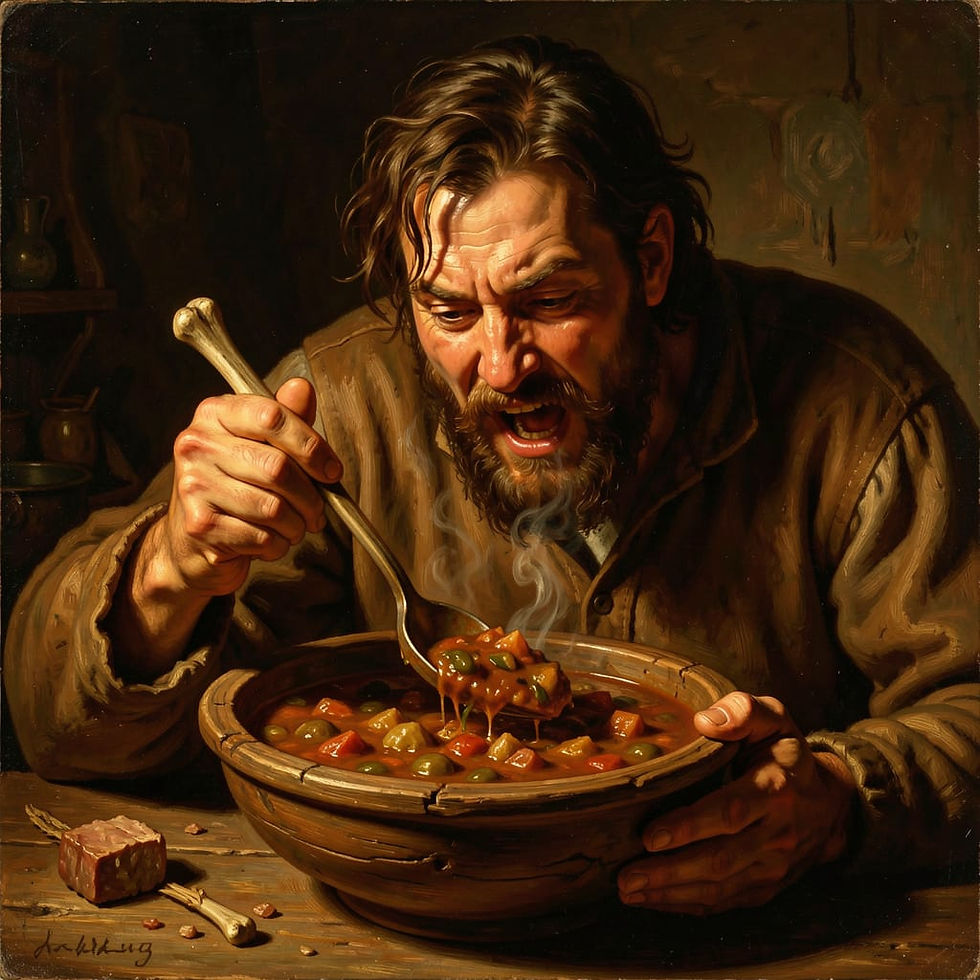
Though Jacob had been born the same day as his brother Esau, Jacob was counted among his people as the younger brother. Esau was the heir to Isaac’s flocks and other material possessions. He would inherit a double portion when their father passed away and was buried with his father, Abraham. Esau had bullied his way into the world, shoving aside his brother to be born first. The younger brother clung to Esau’s heel for dear life. And so they named him Jacob, he takes by the heel. Yes, Esau was a bully—even in the womb.
Their mother Rebekah, had a troubled pregnancy. After watching the other women in the household conceive and give birth, time and again, Rebekah grew worried that she was infertile. She said to her husband, Isaac, “Pray to your God for me! I have left behind my people, as your father did. The God of Abraham gave him a son. Perhaps this God will give one to me.”
So, Isaac did. But maybe a little too hard. At first Rebekah was happy to have conceived. She could put up with a little morning sickness. The other women told her she was glowing. But then, she felt turmoil inside her. It was as if a war was being fought within her womb.
“If it is to be this way, why do I live?” she cried.
This time, Rebekah decided to talk to the God of Abraham herself. Perhaps Isaac had bungled the job. “Oh, God of Abraham,” Rebekah inquired. “I prayed to give birth to a son, not an earthquake!” God replied:
“Two nations are in your womb, and two peoples born of you shall be divided;
The one shall be stronger than the other; the elder shall serve the younger.”
When it came time for the children to be born, Esau just had to be first.
Isaac did not pay attention to the words that the God of his father had given to Rebekah—or maybe he just forgot them. Isaac himself had been the younger son to Ishmael, yet he inherited the birthright from their father Abrahm. Still, Isaac favored Esau. And with the master of the household’s favor went the favor of his servants. After all, Esau would be their boss someday. Encouraged by his father’s favoritism and the ass-kissing of his father’s servants, Esau believed he could do no wrong. Esau grew up a man of the fields, a self-assured brute accustomed to getting whatever he wanted.
But Rebekah had treasured the words that the God of Abraham had spoken to her. She had left behind her kinsfolk and their customs to wander the land with Isaac. Why should Esau inherit Isaac’s belongings just because that was the way these things were always done? Why couldn’t Jacob be the heir? It was, after all, what God had promised. Was it really any different than what God had promised to Isaac?
Rebekah’s words did not carry as much weight in the household as Isaac’s. Jacob was often overlooked, clinging to the heels of his older, much more respected brother, for any access to his measly share or to their father’s possessions. So Rebekah kept Jacob close. He cooked. He cleaned. He learned to water his father’s flocks as his mother had done for her father. Jacob grew up a man of the folds, a careful shepherd accustomed to getting whatever he could.
It happened once that Jacob was making himself a stew. It was nothing fancy. Just a simple lentil stew with barely any vegetables and no meat. Esau never shared the spoils of his hunt with Jacob, and their father would never let Jacob prepare a calf for himself.
Esau came in from the field—soiled and sweaty—and spread himself out on Jacob’s couch. His nose caught the scent of Jacob’s stew.
“I’m famished,” Esau said.
Jacob continued stirring the pot as if he had not heard his brother speak. Perhaps Esau would go away if he failed to get a rise out of Jacob.
“I said, ‘I’m famished.’”
Jacob sighed quietly to himself. “I have only made enough for one,” he replied.
“Well, there’s only one of me,” Esau argued. “Give me a bowl.”
“Have you not just come in from the hunt?” Jacob pleaded. “Surely father’s servants are dressing wild game for you! There is always a feast for Esau. Why do you have to take away my pot of scraps and odds and ends?”
“I’m too hungry to wait,” Esau told him. “If I don’t eat something now, I’ll die of starvation. Just give me the damn stew.”
“Are there no barley cakes or dried figs waiting for you in your own tent?”
Esau smiled the shit-eating grin of the golden child who always gets their way. “Give me the stew, or I’ll perish. You know that father wouldn’t like it if you let me starve.”
Jacob sighed again. He reached for a bowl. But then he had an idea. He smiled a grin of his own—the mischievous grin of the red-headed stepchild who has realized how to get their revenge.
“What will you give me for the stew?” he asked.
“You’ve got to be kidding me,” Esau said.
“What will you give me for the stew? You are starving, aren’t you?”
“What do you want, mama’s boy?” Esau asked angrily.
“Oh, I don’t know. Not much. Just your birthright?”
The tension broke as Esau laughed heartily. Like his father would ever honor such an agreement! Like Esau couldn’t just take back what was rightfully his whenever he wanted! What a pitiful scheme by a pitiful boy. “Yeah, sure. Whatever. Just give me the stew. I’m dead anyway if I don’t eat. What do I need with a birthright?” Esau said.
Esau reached for the bowl, but Jacob pulled it back. “You must swear it to me first!”
“You must be mad if you think I’m going to put my hand under your thigh.”
“Then swear by the God of our father Isaac and of his father Abraham!” Jacob cried. “Swear it in front of these witnesses!”
By now, a crowd of their father’s servants had gathered to witness the altercation. Even Isaac and Rebekah had drawn near to listen to what would become of the commotion.
“I swear,” Esau said.
“By the God of our father—”
“By the God of our father Isaac and by the God of his father Abraham” Esau hastily muttered through gritted teeth. He could not help but feel that Jacob was getting the better of him, but he had to look like he was the one who was in control. “Now give me that damn stew already!”
The crowd began to disperse as Esau greedily and messily ate the stew. Isaac shook his head, but Rebekah smiled quietly to herself. Jacob stood by smiling as well.
Esau turned toward his brother and to those who had not yet cleared off. “I’ve bought my meal,” he barked, his face red with both stew and anger. “Does it not also buy me some peace and privacy?”
The rest of the servants scattered—one to water the flocks, another to the well to draw water. Jacob, too, was kicked out of his own tent. His smile quickly vanished as we made his way toward the flocks. Behind him, Jacob could hear his brother Esau grunting to himself. “This stew tastes like shit.”
Edited by Welby Delinois
Comments